Vendors and transfers · DP055
Using contractors without handing over unrestricted customer access
Give contractors access that fits the task, lasts for the engagement and can be withdrawn without disrupting the business.
Research cutoff: . This dated explainer is general information; check the linked instruments and your circumstances before acting.

A contractor may need to resolve twenty delivery queries. Giving them the full customer database is an easy shortcut, but it silently turns a limited assignment into broad, continuing access. The better starting point is the task itself: which people, which fields, which actions and which dates are necessary?
You do not need an elaborate procurement department to answer those questions. A clear assignment, an appropriate agreement and a controlled access route can make the relationship much easier to manage.
Classify the work before granting the account
The DPDP definitions distinguish a Data Fiduciary deciding purposes and means from a Data Processor acting on its behalf. The same organisation can occupy different roles in different activities. Section 2(i) and 2(k) are the starting point, not the label ‘freelancer’ or ‘consultant’ on an invoice.
As of 22 October 2026, the relevant substantive duties are scheduled for 13 May 2027 under the commencement notification. When they commence, section 8(1) and 8(2) will preserve the fiduciary’s accountability and require the specified processor engagement to rest on a valid contract. Rule 6 will include access controls and processor-contract safeguards among the security requirements. The practical choices below prepare for that framework.
Translate the assignment into permissions
Write a short description of the work and identify the fields required to complete it. A delivery resolver might need an order reference, delivery status and a current contact route. Purchase history, unrelated service notes and identity documents may add nothing useful.
Then specify actions. Reading a record, correcting an address, exporting a list and inviting another user are different permissions. A person authorised to read a queue does not automatically need permission to download every record in it. If the system supports a restricted view, use that before sending a spreadsheet. Where an export is necessary, narrow its rows and columns and define how the copy will be handled.
Set a time boundary. Give the account a named owner, an expected end date and a review point for extensions. An automatic expiry can help where available, but somebody still needs to confirm that the underlying task has ended. Avoid shared accounts that make it difficult to separate authorised work from an unexplained action.
A hypothetical seasonal support assignment
A small online retailer hires a contractor for a festive-season backlog. The initial request is to contact customers whose parcels have failed delivery. Instead of handing over the marketing database, the retailer creates a restricted queue containing those orders and a way to record the outcome.
The contractor can update a delivery instruction but cannot change promotional preferences, download the wider customer list or create other accounts. If a customer asks about an unrelated purchase, the contractor passes the query to an employee with the appropriate remit. That boundary avoids expanding the account every time an unusual question appears.
At the end of the assignment, the employee who owns the queue checks outstanding items, removes the contractor’s access and confirms the treatment of any approved working copies. The record of completion identifies what was checked. It does not simply repeat that the contractor signed a confidentiality clause.
Make the agreement usable
Document the permitted task, instructions, approved systems, confidentiality expectations, restrictions on further sharing, incident escalation and the return or erasure process. Address downstream help explicitly: can the contractor bring in an assistant, and what review is needed before that person sees customer information?
A confidentiality promise is useful, but it does not technically restrict a download or ensure a message reaches you when something goes wrong. Pair contractual instructions with the access design. Give the contractor a reachable contact and explain what to do if they receive information outside the agreed scope.
Review actions without building another risky dataset
Keep enough access evidence to investigate unusual activity and demonstrate the account’s lifecycle. Protect those records and apply relevant retention requirements. Do not copy every customer conversation into a separate monitoring spreadsheet merely to prove that the contractor worked.
The common failure is granting an administrator account because a limited role cannot perform one small action. Investigate the missing action first. It may be safer for an employee to perform that step, for a process to change, or for a separate controlled approval to be added.
When the task changes, repeat the permissions conversation. A contractor moving from delivery support to marketing research has a new assignment and potentially a new purpose. Treat that as a decision requiring explanation, not an automatic extension of the original access.
Turn a task into bounded access
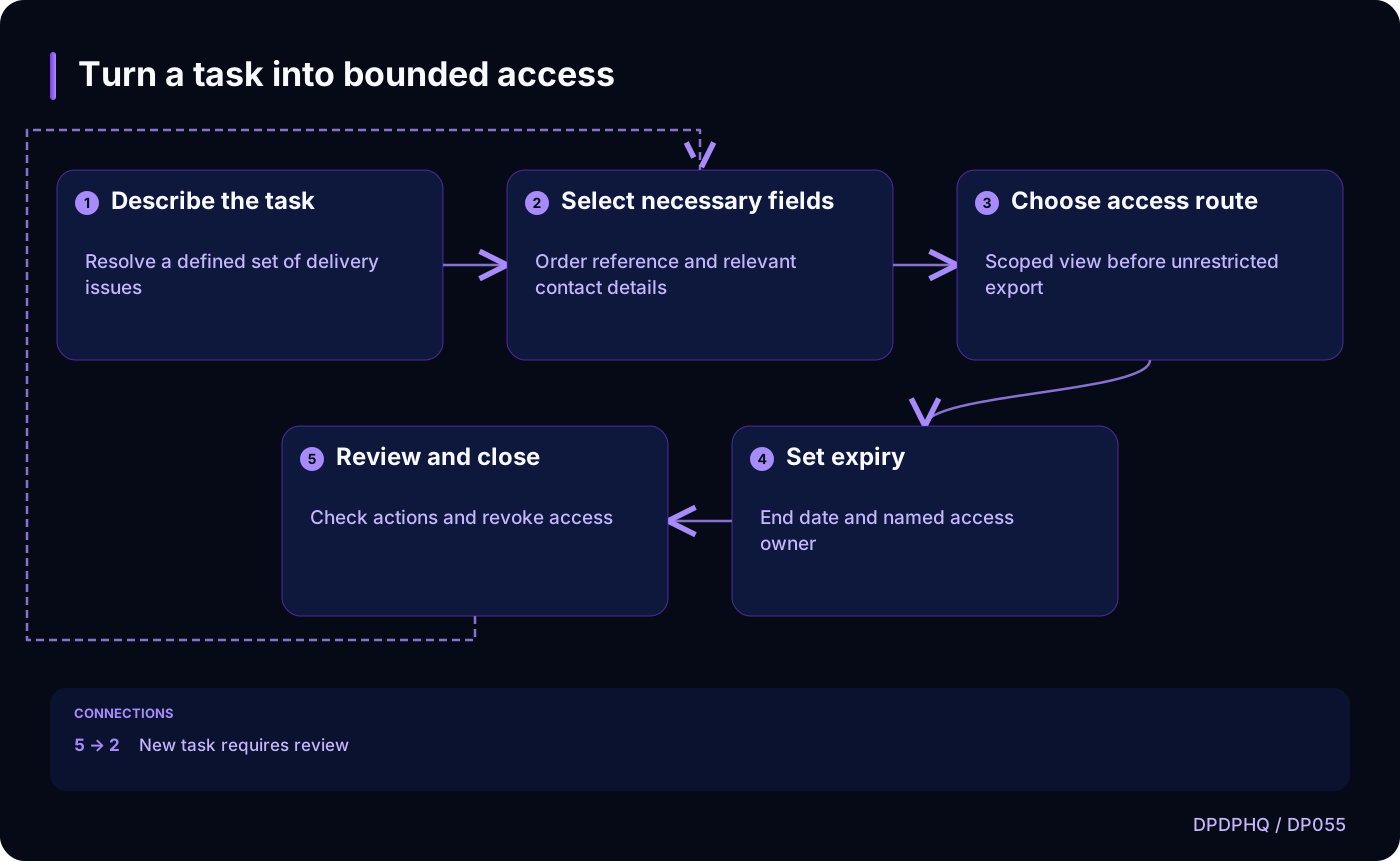
Text version of the diagram
- Describe the task: Resolve a defined set of delivery issues
- Select necessary fields: Order reference and relevant contact details
- Choose access route: Scoped view before unrestricted export
- Set expiry: End date and named access owner
- Review and close: Check actions and revoke access
- Describe the task → Select necessary fields
- Select necessary fields → Choose access route
- Choose access route → Set expiry
- Set expiry → Review and close
- Review and close → Select necessary fields: New task requires review
Sources and reading context
These references support the original 22 October 2026 research. Source links and the date above make the scope of this article explicit.
- Commencement notification for provisions of the DPDP Act · paragraph (c)
Dates the substantive framework
- Digital Personal Data Protection Act, 2023 · sections 2(i), 2(k), 8(1), 8(2)
Explains role classification and accountability
- Digital Personal Data Protection Rules, 2025 · rule 6
Supports access controls and processor safeguards