Governance and accountability · DP030
Training frontline staff to handle personal data sensibly
Train frontline staff with realistic customer situations, clear escalation routes and simple habits for handling forms, messages and personal information.
Research cutoff: . This dated explainer is general information; check the linked instruments and your circumstances before acting.

The employee at the counter often makes the privacy decision before anyone calls it a privacy decision. They choose whether to ask for a second phone number, photograph an identity document or forward an order to a personal messaging group. A useful training session starts with those choices.
The main DPDP duties are scheduled for 13 May 2027, according to the commencement notification. As of 22 October 2026, teams can build the habits and processes needed for that phase while checking obligations that already apply to their business. Training is a practical safeguard, not evidence that every legal requirement has been met.
Teach the job, then explain the boundary
A cashier needs to know which fields an invoice process requires, what is optional and whom to ask when the customer declines. A delivery coordinator needs a different lesson: which details a driver receives, how long they need them and where delivery photographs belong.
Create a short role card with three headings: collect, use and escalate. Put real tasks beneath each. For example, “Use the delivery address for the order” is clearer than “Observe purpose limitation.” Explain the principle after staff understand the action.
The future consent provisions in section 6 require meaningful, specific agreement and limit consent to personal data necessary for the specified purpose. Staff should therefore avoid presenting optional promotional permission as a condition of ordinary service without a valid basis.
Practise four ordinary conversations
First, a customer asks why a birth date is required. The employee should explain the approved purpose or identify the field as optional. “The system needs it” leaves the customer without an answer and hides a possible design problem.
Second, a customer says to stop promotional messages. Staff should know how to record the request and route it to the person controlling the audience. They should not promise that every business record will disappear immediately. Withdrawal and retention involve different questions under sections 6 and 8.
Third, a caller asks for a family member’s purchase history. The employee should follow an appropriate verification and authorisation route, rather than treating familiarity with the family name as sufficient. A legitimate representative may exist, but the frontline worker should not improvise the proof required.
Fourth, a colleague sends customer details to the wrong group. The right first response is prompt internal reporting and containment through an approved route. Concealing a mistake prevents the organisation from understanding its scale and taking corrective action.
Use a worked scenario from the business
Imagine a hypothetical neighbourhood appliance shop. An employee takes a repair request, including the customer’s address and a photograph of the faulty appliance. The photograph also shows a medicine label and a child’s school card on a nearby shelf.
Ask the group what information the technician needs. Can the customer retake the photograph? Can the employee use an approved cropping process? Should the original image remain in a personal phone gallery? The exercise makes unnecessary collection visible without requiring staff to memorise statutory language.
Then change one fact: the technician forwards the entire chat to another repairer. Discuss the permitted sharing route, contract arrangements and escalation. A scenario becomes useful when staff must make a decision, not merely repeat a slogan.
Make reporting safe and specific
Give staff one reliable contact and a backup. Explain what to report: the system, approximate time, information involved, recipients and actions already taken. Do not encourage speculation or deletion of evidence to make an incident disappear.
Future Rule 6 includes appropriate technical and organisational measures, while Rule 7 addresses breach information. Training supports those processes, but reporting deadlines belong in the response team’s playbook. Frontline staff need an immediate escalation route, not responsibility for making complex regulatory decisions alone.
Use ordinary language and the languages employees understand. Provide an accessible alternative to text-heavy training where needed. An employee who can demonstrate the process is more useful than one who has clicked through an unread presentation.
Check behaviour after the session
A week later, ask each role to demonstrate one task: recording a withdrawal, finding the privacy contact or sharing an approved delivery list. Correct a confusing screen or workflow when staff cannot follow the instruction. Repeating the same training cannot repair a system that makes the wrong action easiest.
Keep a record of the date, roles trained, scenarios used and practical gaps found. Refresh training when the process changes or an incident reveals a weakness. Attendance matters, but the stronger evidence is that people can perform the task and know when to seek help.
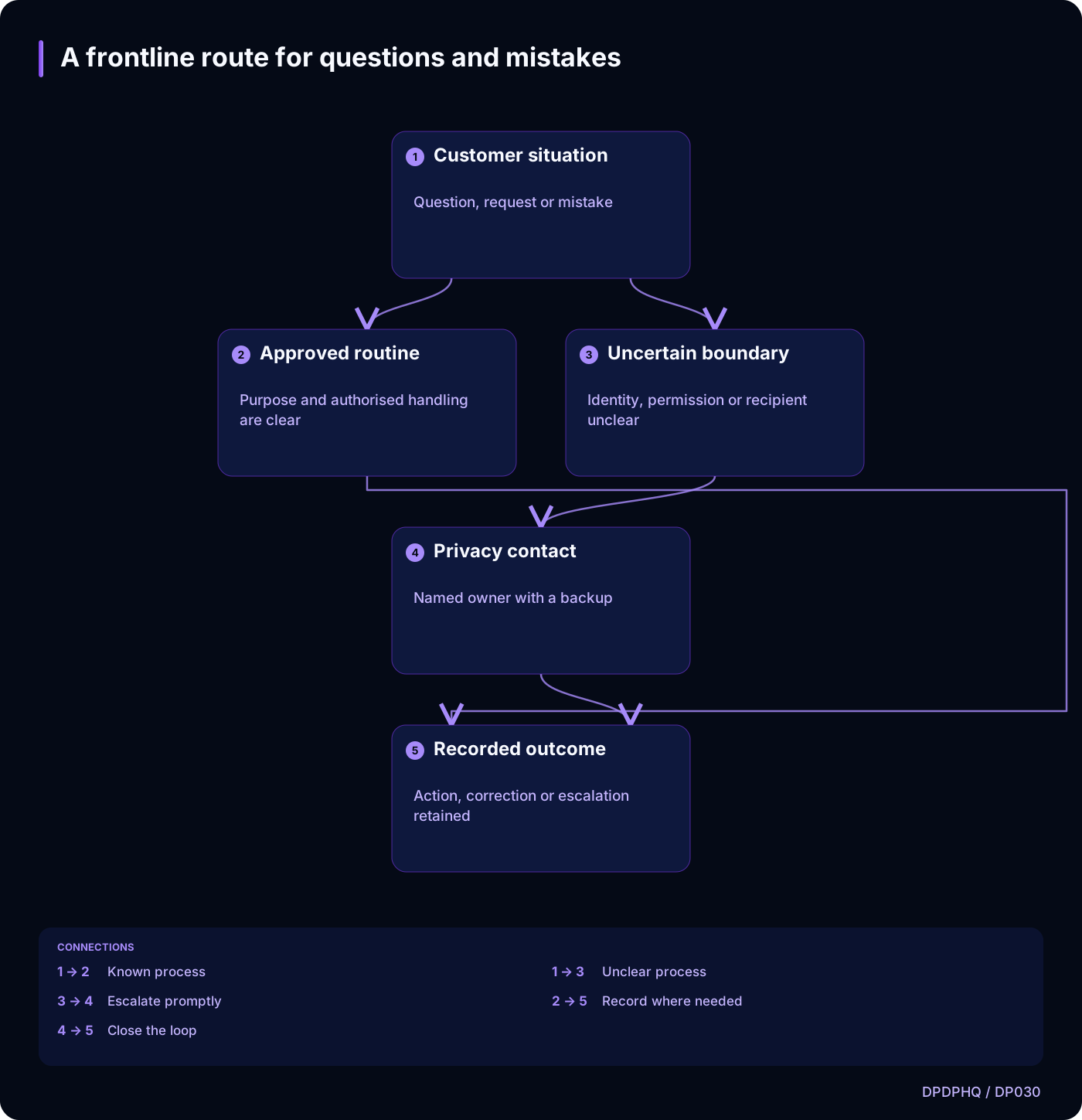
A frontline route for questions and mistakes
Text version of the diagram
- Customer situation: Question, request or mistake
- Approved routine: Purpose and authorised handling are clear
- Uncertain boundary: Identity, permission or recipient unclear
- Privacy contact: Named owner with a backup
- Recorded outcome: Action, correction or escalation retained
- Customer situation → Approved routine: Known process
- Customer situation → Uncertain boundary: Unclear process
- Uncertain boundary → Privacy contact: Escalate promptly
- Approved routine → Recorded outcome: Record where needed
- Privacy contact → Recorded outcome: Close the loop
Sources and reading context
These references support the original 22 October 2026 research. Source links and the date above make the scope of this article explicit.
- Commencement notification for provisions of the DPDP Act · Paragraph (c)
Commencement of business obligations
- Digital Personal Data Protection Act, 2023 · Sections 6 and 8
Consent, withdrawal and business obligations
- Digital Personal Data Protection Rules, 2025 · Rules 6 and 7
Organisational safeguards and incident handling