AI and product decisions · DP088
Human review needs privacy controls too
Give human reviewers only the information and permissions their judgment requires, with a controlled escalation path for harder cases.
Research cutoff: . This dated explainer is general information; check the linked instruments and your circumstances before acting.

‘A human will review it’ can sound like the end of a privacy discussion. In practice, review creates another data-access path. The reviewer may see a full conversation, download attachments, add notes and share a difficult case with a colleague. Those actions need a deliberate design too.
Start by specifying the judgment the reviewer must make. Then give that person the information and authority needed for that judgment, with a controlled route for cases that need more context.
Separate oversight from unrestricted access
A reviewer checking whether a response answers a delivery question may not need the customer’s complete account history. Someone resolving an identity-related dispute may need a different view. The word ‘reviewer’ does not describe one universal permission level.
NIST IR 8062 provides a privacy-engineering risk model that considers problematic data actions, including within an authorised environment. It helps frame the practical question: what should an authorised person be able to see and do for this task? It is technical guidance, not an Indian statutory rulebook.
As of 22 October 2026, the relevant substantive DPDP duties are scheduled for 13 May 2027 under the commencement notification. The future section 8(1) and 8(5) and rule 6 framework will address accountability and safeguards, including access controls. Human review belongs in that assessment rather than outside it.
Design a useful first view
Show the relevant content, the reason the case was routed for review and the decision the reviewer can make. Hide unnecessary identifiers where doing so preserves the task, but do not pretend masking alone makes the material anonymous.
Avoid forcing reviewers to guess with too little context. A limited view should be sufficient for the ordinary decision, and it should include an escalation option when it is not. Otherwise, staff may create informal copies or request broad access outside the intended process.
Define the available actions separately. Reading a case, changing a result, exporting a document and contacting the person are different permissions. A reviewer may need one without needing all of them.
A hypothetical AI-response review queue
A business uses an assistant to draft replies to service questions. Its review queue initially displays the entire customer profile beside each draft. The team identifies the actual review task: check that the draft addresses the current issue, is accurate and does not disclose inappropriate information.
The ordinary view is narrowed to the relevant conversation and necessary order context. If the reviewer needs an additional record, they request it through a defined escalation with a reason. The system records the decision and the relevant version without copying the whole profile into a separate review spreadsheet.
The team tests an ordinary case, a case needing more context and a case that should be referred to a different role. It checks whether the reviewer can complete the task without unnecessary access and whether escalation is usable under normal workload.
Keep review notes focused
Notes should explain the decision, not reproduce every private detail visible on screen. Use a bounded reason where that is sufficient, with a restricted reference to supporting material when more is necessary. Avoid adding speculation about a person that is unrelated to the task.
Where review information is likely to be used for a decision affecting the person, the future section 8(3) accuracy obligation in its specified context becomes relevant. Provide a way to correct a material error and ensure the correction reaches the decision record. A human-authored note is not automatically more reliable than the information it summarises.
Include external reviewers and exceptional access
If another organisation supplies reviewers, assess the actual role, instructions, contract, access conditions and incident route. Do not assume that outsourcing the review transfers accountability. Check whether the external team can download records, involve additional people or use its own tools.
Plan time-limited exceptional access. Record why it was granted, who approved it and when it ends. A temporary investigation should not leave a permanent broad permission behind.
Review staff changes and inactive accounts, and give reviewers an approved route for reporting an accidental disclosure. The process should be clear enough to use without improvising during a difficult case.
Measure the review process honestly
Track whether reviewers have enough context, how often they escalate and which decisions require correction. Do not turn throughput alone into a quality measure or claim that human involvement guarantees a safe result. Inspect meaningful failures and improve the task design.
The recurring failure is treating the reviewer as an unlimited safety net. Human judgment is more useful when the question, information, permissions and evidence are all defined. That makes oversight both more accountable and less dependent on unnecessary exposure.
Match reviewer visibility to the decision
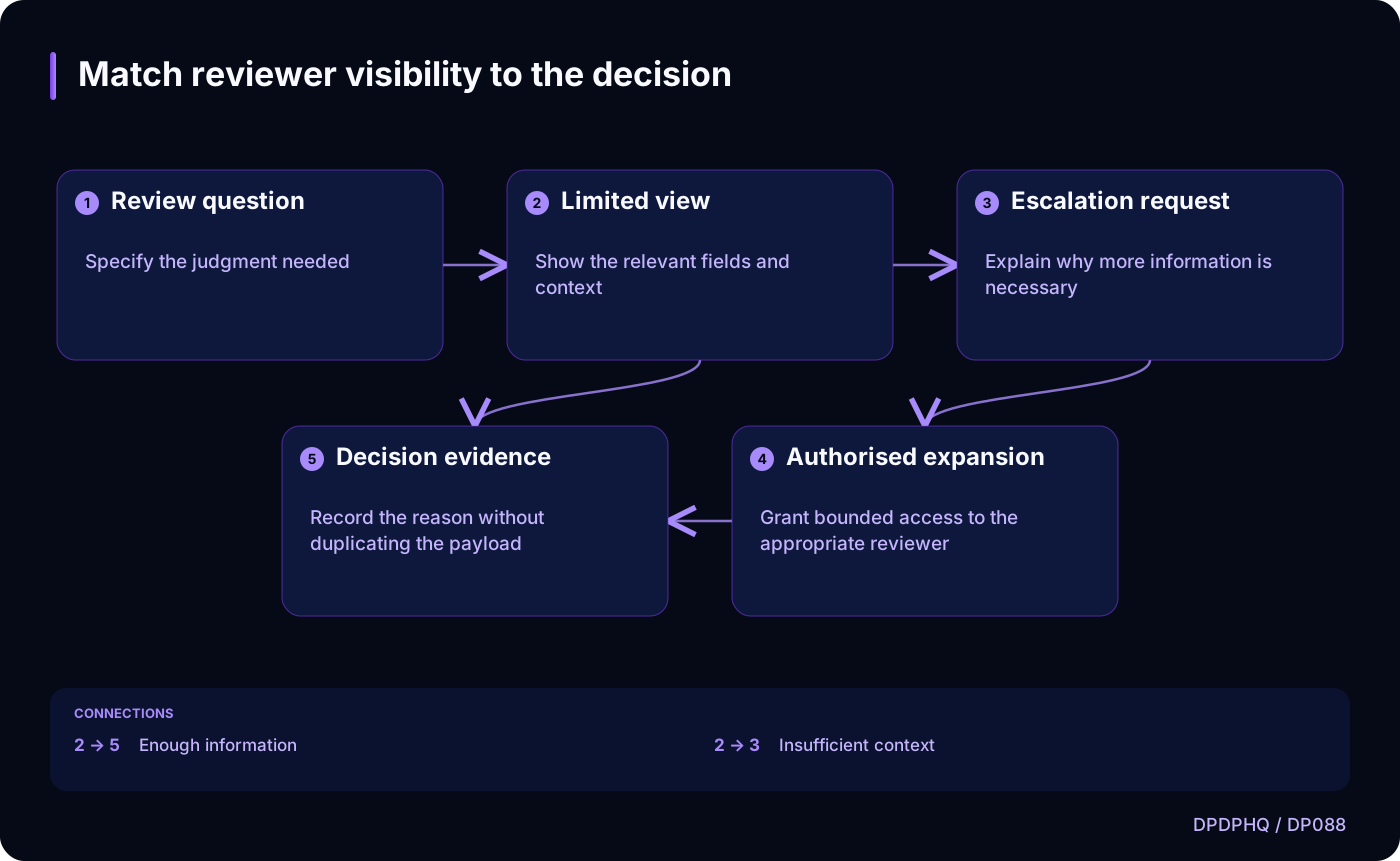
Text version of the diagram
- Review question: Specify the judgment needed
- Limited view: Show the relevant fields and context
- Escalation request: Explain why more information is necessary
- Authorised expansion: Grant bounded access to the appropriate reviewer
- Decision evidence: Record the reason without duplicating the payload
- Review question → Limited view
- Limited view → Decision evidence: Enough information
- Limited view → Escalation request: Insufficient context
- Escalation request → Authorised expansion
- Authorised expansion → Decision evidence
Sources and reading context
These references support the original 22 October 2026 research. Source links and the date above make the scope of this article explicit.
- Commencement notification for provisions of the DPDP Act · paragraph (c)
Dates future safeguards
- Digital Personal Data Protection Act, 2023 · sections 8(1), 8(3), 8(5)
Accountability, decision accuracy and security
- Digital Personal Data Protection Rules, 2025 · rule 6
Access and related safeguards
- NIST IR 8062: An Introduction to Privacy Engineering and Risk Management in Federal Systems · Privacy risk model and engineering objectives
Supports considering risks inside authorised processing