Interpretation and common mistakes · DP101
Does every business need a Data Protection Officer?
Distinguish the statutory DPO role for Significant Data Fiduciaries from the general need for a responsive privacy contact.
Research cutoff: . This dated explainer is general information; check the linked instruments and your circumstances before acting.

Imagine a small business receiving a proposal to appoint a Data Protection Officer immediately because “DPDP requires one for every company.” Before approving the retainer, the owner should ask which provision supports that statement. The Act distinguishes a statutory DPO from the wider need for someone who can answer privacy questions.
Under section 10, the appointment requirement belongs to a Significant Data Fiduciary, or SDF. That status depends on a Central Government notification identifying a fiduciary or class of fiduciaries. It does not arise automatically because a company uses customer software or has crossed an invented employee threshold.
At 22 October 2026, the relevant substantive provisions are scheduled to commence on 13 May 2027 under the commencement notification. No specific SDF designation applicable to a hypothetical reader has been established by this article. Check the relevant notification and facts before asserting either that the role is mandatory or that it can be ignored.
Designation is a legal step
The factors in section 10(1) include the volume and sensitivity of personal data, risks to Data Principal rights and specified public interests. The statute does not give every business a universal turnover or headcount threshold that automatically determines SDF status.
A hypothetical national service holding substantial personal data should monitor the designation framework and assess readiness. A neighbourhood repair shop should do the same proportionately. Neither should replace the notification question with a vendor’s size-based sales rule.
Document who checks for relevant developments and how a designation would reach management. If a notification covers a class, examine whether the business falls within that class. The analysis should identify the actual instrument rather than rely on a circulated screenshot.
The statutory DPO role has particular features
Under section 10(2)(a), an SDF’s DPO must represent it under the Act, be based in India, be responsible to its board of directors or similar governing body, and act as the contact for its grievance-redressal mechanism. Those features matter when evaluating a proposed appointment.
Buying an email address labelled “DPO” does not establish that an individual has the required position, responsibility or ability to perform the role. Ask how the person receives information, raises unresolved risks and reaches the governing body. Clarify the support available from operations, technology and legal teams.
SDF obligations also include an independent data auditor and periodic assessments. Rule 13 addresses a DPIA and audit in each twelve-month period from designation or inclusion in a notified class. It should not be paraphrased as a universal annual DPDP audit requirement for every Indian business.
Other fiduciaries still need a reachable person
The future section 8(9) will require publication of the business contact information of a DPO, where applicable, or a person able to answer questions about processing on the fiduciary’s behalf. Section 8(10) addresses an effective grievance mechanism. Rule 9 specifies publication on the website or app and in responses to communications for exercising rights.
For the hypothetical repair shop, the owner might assign a trained operations manager as the privacy contact, with a monitored mailbox and backup coverage. That is an operational example, not a claim that a particular staffing model always satisfies the law. The key question is whether the arrangement can actually answer and resolve the relevant inquiry.
The contact should know where customer information is held, which suppliers assist the business and who can authorise corrections or stop a use. A publicly listed address that nobody checks creates the appearance of a process without the process itself.
Test the role through a real task
Before signing a service agreement, run a hypothetical request: a customer asks why the business holds an old address and wants it corrected. Can the proposed contact locate the record, identify copies, involve the right system owner and explain the outcome?
Then test escalation. What happens when a supplier does not respond, the contact is absent or management disagrees with the recommended action? Record responsibilities and an escalation route in terms people can use during a busy week.
Businesses may voluntarily create stronger privacy leadership than the statutory minimum. Other laws, contracts or organisational needs may also influence staffing. Describe that choice honestly instead of presenting every useful appointment as a universal DPDP mandate.
The failure to avoid is treating the title as the control. First establish which role the law requires, then provide the authority, information and coverage that make the role effective.
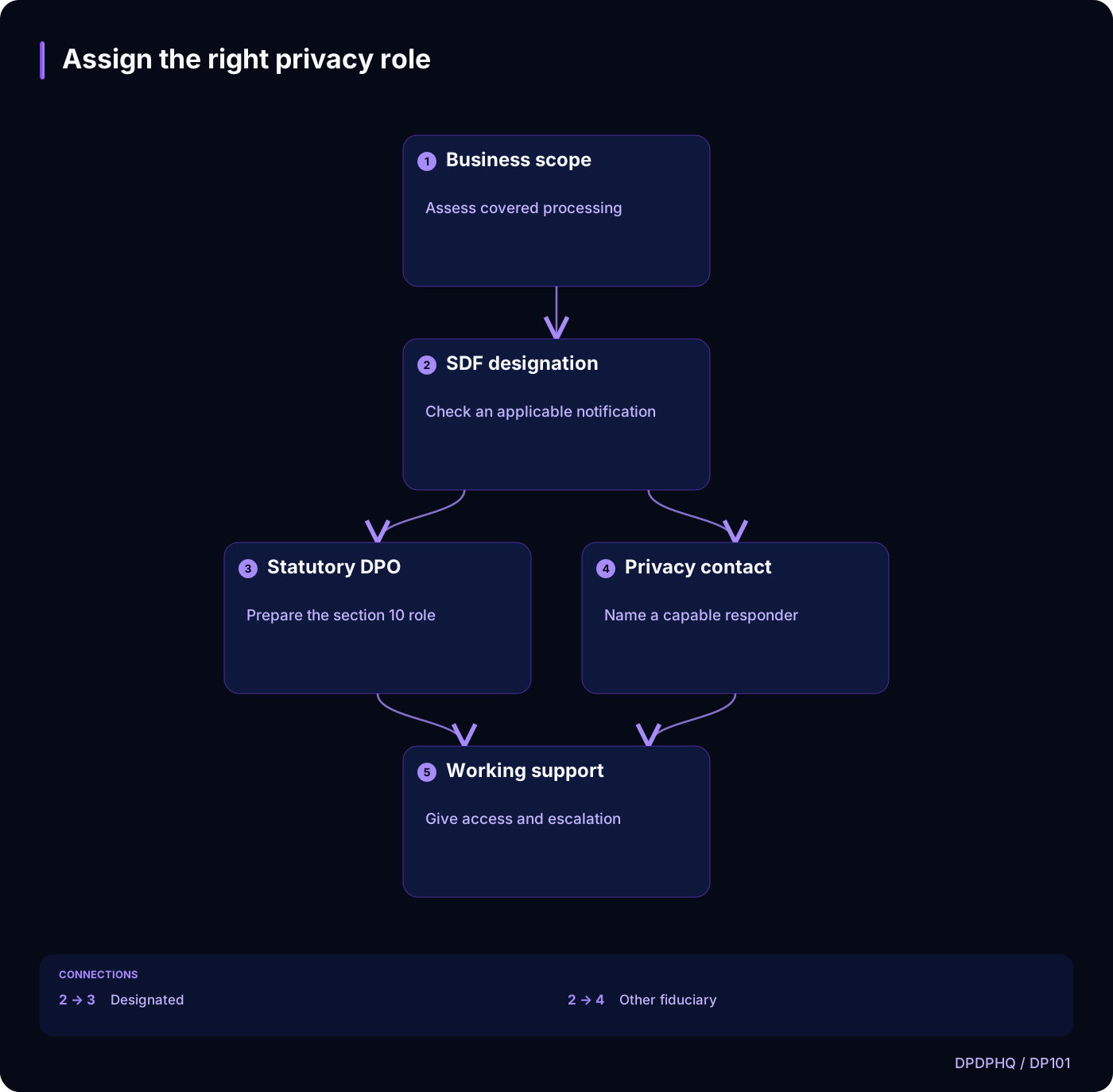
Assign the right privacy role
Text version of the diagram
- Business scope: Assess covered processing
- SDF designation: Check an applicable notification
- Statutory DPO: Prepare the section 10 role
- Privacy contact: Name a capable responder
- Working support: Give access and escalation
- Business scope → SDF designation
- SDF designation → Statutory DPO: Designated
- SDF designation → Privacy contact: Other fiduciary
- Statutory DPO → Working support
- Privacy contact → Working support
Sources and reading context
These references support the original 22 October 2026 research. Source links and the date above make the scope of this article explicit.
- Digital Personal Data Protection Act, 2023 · Sections 2(l), 8(9), 8(10) and 10
DPO definition, general contact obligations and SDF duties
- Digital Personal Data Protection Rules, 2025 · Rules 9 and 13
Publication of contact information and SDF assessment cadence
- Commencement notification for provisions of the DPDP Act · Commencement notification
Relevant substantive obligations remain prospective