Education and children · DP072
Building a privacy handover between admissions and delivery teams
Move an admitted student into service delivery with the necessary records, current choices and clear ownership of unresolved issues.
Research cutoff: . This dated explainer is general information; check the linked instruments and your circumstances before acting.

The admissions team has secured the enrolment. The teaching team needs to begin the service. Between those events, a large spreadsheet can move across the organisation containing everything collected during the enquiry: contact details, sales notes, application documents, preferences and unresolved questions.
A better handover is selective. It gives the receiving team what it needs to deliver the agreed service, carries forward relevant choices and corrections, and leaves unrelated material outside the everyday working view.
Begin with the receiving team’s task
Ask the delivery team to describe its first week of work. Which information is needed to place the student in a class, communicate appropriately, arrange justified support and resolve an open issue? Compare that list with the admissions export before sending it.
As of 22 October 2026, the relevant substantive DPDP duties are scheduled for 13 May 2027 under the commencement notification. The future sections 5 and 6 will matter to the relevant notice and consent-based purposes, while section 8(3) will address accuracy in its specified decision and disclosure contexts. The handover process below is a practical readiness method.
Where the student is a child, include the relevant section 9 assessment and the applicable permission or exemption reasoning. Do not let the move between teams erase the conditions that governed collection.
Transfer the governing decisions with the data
A receiving team needs to know which contact is current, which communication route is suitable, which information has been corrected and which optional uses have been declined. A spreadsheet containing only the latest phone number can lose the context needed to use it properly.
Keep the handover proportionate. The recipient may need a clear status and a link to restricted supporting evidence, rather than copies of identity documents or private family explanations. Define who can open that evidence when a legitimate task requires it.
For unresolved matters, transfer a question and an owner. ‘Needs review’ without responsibility is likely to remain unresolved. Record the next action and what the receiving team should avoid doing until the issue is settled.
A hypothetical language-school handover
A language school enrols a teenager after a parent’s enquiry. Admissions has the class choice, the current parent contact, a correction to the student’s name and a record that public promotional photographs were declined. It also holds internal notes about the likelihood of the family purchasing another course.
The teaching team receives the class placement, correct name, relevant contact arrangements and the applicable publication restriction through an appropriate staff-facing view. It does not receive the sales-likelihood commentary. Supporting permission evidence remains accessible only to the people who need to administer it.
One issue remains open: a requested timetable adjustment has not been confirmed. The handover identifies the delivery manager responsible for the answer. The admissions team does not mark the record complete until the receiving owner accepts that responsibility.
Test the receiving view
Use a synthetic student record to check what actually appears after transfer. Does the corrected name reach the class list? Does an old contact remain in a reminder system? Can a publicity user see a restricted note? Does the teaching team understand the condition without reading unnecessary private background?
Rule 6 will include access controls and related safeguards in the future framework. As preparation, match the view to the task and check permissions in connected tools, not just the main student system. A carefully narrowed export can be undermined if everybody still has access to the original admissions folder.
Close the previous working stage
After acceptance, decide which admissions working views remain necessary. Remove obsolete access and review duplicated exports. Do not assume that the receiving team’s successful import justifies indefinite storage of every migration file.
The future section 8(7) framework must be read with applicable retention requirements, including rule 8(3) and the Seventh Schedule. Distinguish restricted retained records from information still available for active admissions or marketing use. The handover is a useful event for that review, not a universal legal deletion deadline.
Keep a short completion record identifying the transferred scope, the recipient, the checked corrections, the unresolved issues and the access changes. It should be possible to explain the handover without reconstructing it from scattered emails.
The common failure is moving fields while leaving decisions behind. A good handover preserves the student’s current position and gives each team a clear reason for the information it can see. That makes the next stage more reliable for both the institution and the family.
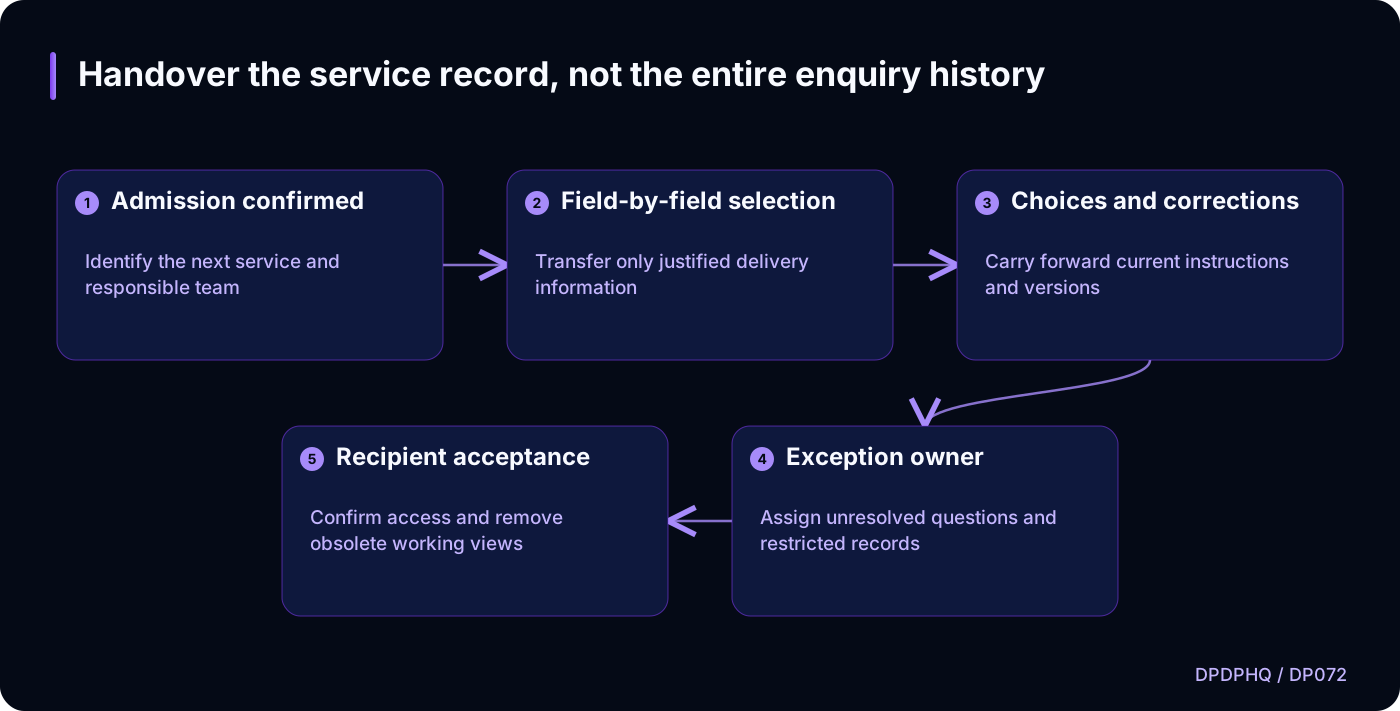
Handover the service record, not the entire enquiry history
Text version of the diagram
- Admission confirmed: Identify the next service and responsible team
- Field-by-field selection: Transfer only justified delivery information
- Choices and corrections: Carry forward current instructions and versions
- Exception owner: Assign unresolved questions and restricted records
- Recipient acceptance: Confirm access and remove obsolete working views
- Admission confirmed → Field-by-field selection
- Field-by-field selection → Choices and corrections
- Choices and corrections → Exception owner
- Exception owner → Recipient acceptance
Sources and reading context
These references support the original 22 October 2026 research. Source links and the date above make the scope of this article explicit.
- Commencement notification for provisions of the DPDP Act · paragraph (c)
Dates future duties
- Digital Personal Data Protection Act, 2023 · sections 5, 6, 8(3), 8(7), 9
Purpose, accuracy, retention and children considerations
- Digital Personal Data Protection Rules, 2025 · rules 6 and 8(3); Seventh Schedule
Access safeguards and retention boundaries