Rights and grievances · DP020
Building a grievance channel that reaches a real person
Build a privacy grievance channel with a real owner, reliable routing and clear responses, while keeping DPDP’s future ninety-day ceiling separate from other deadlines.
Research cutoff: . This dated explainer is general information; check the linked instruments and your circumstances before acting.

A published privacy email address creates an expectation that someone will read it. If the mailbox forwards to a former employee, receives no acknowledgement or requires an administrator nobody can find, the grievance process exists mainly on paper.
The DPDP framework requires an effective grievance mechanism and readily available means of redress. Section 13 requires the individual to exhaust that route before approaching the Board. As of 22 October 2026, these substantive provisions are scheduled for May 2027 under the commencement notification. Preparation should focus on the route’s actual operation.
Give the channel an owner and a deputy
The owner needs authority to obtain facts from operations, technology, finance and vendors. They do not need to personally perform every investigation, but they must be able to keep it moving and recognise when a decision needs escalation.
Name a deputy for absence and a senior decision-maker for difficult cases. Avoid assigning the channel to a generic department without checking who receives notifications. Test the mailbox or form from outside the organisation, including whether automated replies reach ordinary consumer email accounts.
Rule 9 addresses publication of the business contact of the DPO where applicable or another person able to answer processing questions. An ordinary fiduciary should not invent a statutory DPO requirement for itself merely because it needs a reliable contact.
Distinguish a request from a grievance
A customer may ask for an address correction. Later, they may complain that the correction was not applied and information went to the wrong person. The second communication needs investigation of the failure, not another routine instruction to fill out the original form.
Use a simple classification that staff understand: question, rights request, grievance and possible incident. A single message can fit more than one category. Routing a suspected disclosure into a slow complaint queue can delay urgent incident action.
Do not force the customer to classify the issue correctly. Frontline staff should recognise a privacy concern in ordinary language and send it to the owner with the original message and relevant context.
A hypothetical complaint journey
Consider a travel agency whose customer says promotional messages continued after withdrawal. The grievance owner confirms receipt, checks the identity match and obtains the preference history, campaign export and vendor response.
The investigation finds that the main account changed but a scheduled audience file did not. The agency stops the remaining use, checks whether other customers were affected, explains the outcome and records the process repair. A response saying “we have updated your preferences” would miss both the cause and the wider issue.
The customer-facing explanation should be specific enough to show that the concern was understood. It need not disclose every internal investigation note, but it should distinguish confirmed facts, corrective action and unresolved limitations.
Publish a realistic response period
Rule 14(3) calls for a reasonable published grievance-response period not exceeding ninety days, backed by measures to meet it. This is not a reason to make every complaint wait ninety days. Set internal targets that reflect urgency, complexity and the ability to respond meaningfully.
Do not copy that ceiling into every rights request or every existing legal regime. For example, the 2011 SPDI Rules contain a one-month grievance-redressal provision within their own scope. Other sector rules may impose different requirements. During transition, the business needs a clear view of which route and obligation applies.
If further investigation is needed, communicate progress honestly. An automatic acknowledgement is useful, but it should not be presented as a completed substantive response. Keep the customer informed of the next step without making promises the team cannot meet.
Measure the failures the channel reveals
Track age, owner, category, outcome and recurrence. A small team can use a controlled ticket register. Limit access and avoid copying full identity documents or sensitive records into unnecessary fields.
Review patterns with the people who can change the workflow. Several complaints about inaccessible withdrawal may indicate a design problem. Repeated wrong-person responses may indicate weak identity matching. Treat the channel as evidence about the service rather than merely a queue to close.
Finally, test the deputy route and an urgent escalation. A customer should be able to reach a responsible person when the usual owner is away. That is the practical standard behind a grievance mechanism that works beyond its published contact details.
From privacy concern to accountable response
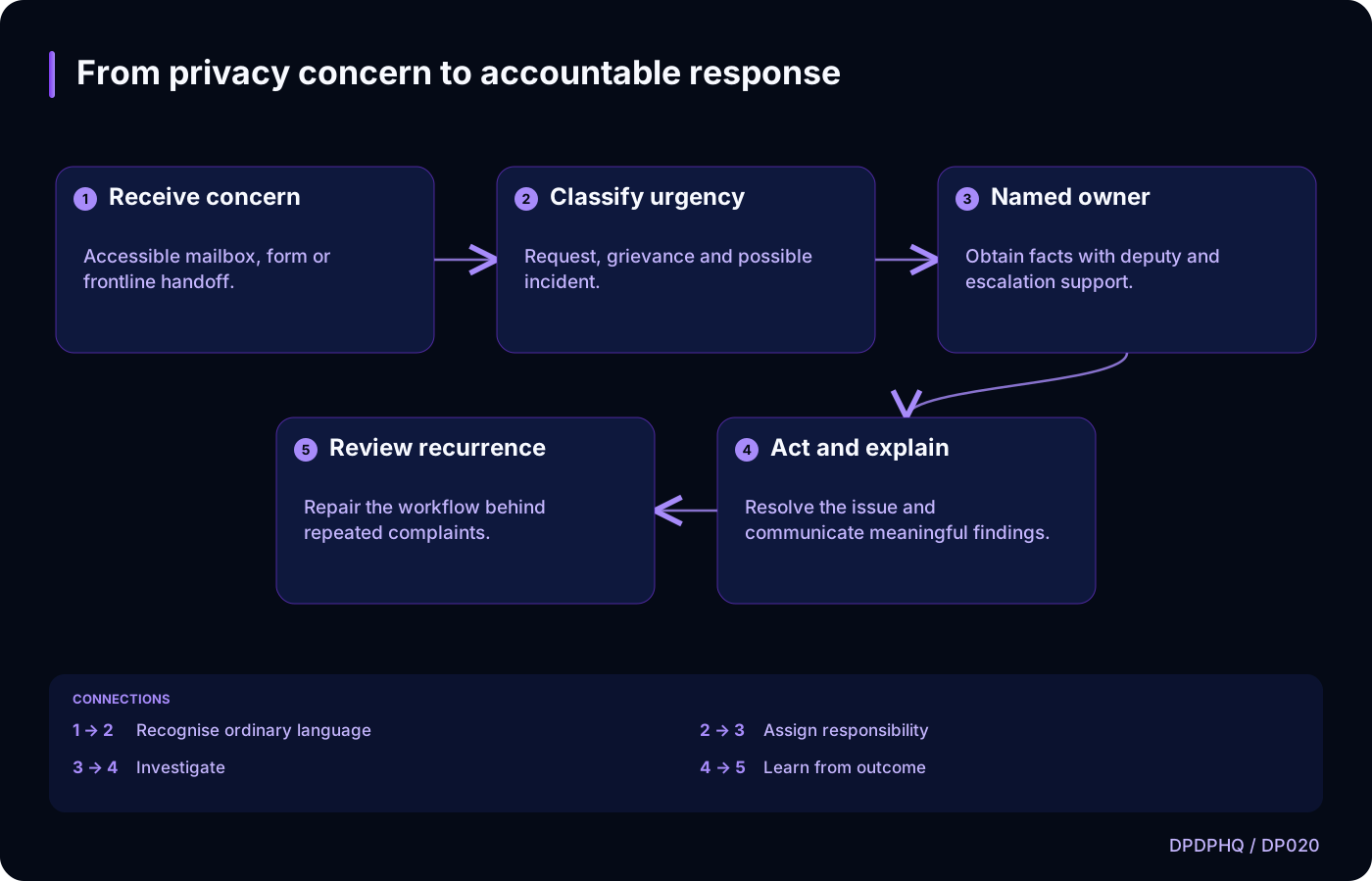
Text version of the diagram
- Receive concern: Accessible mailbox, form or frontline handoff.
- Classify urgency: Request, grievance and possible incident.
- Named owner: Obtain facts with deputy and escalation support.
- Act and explain: Resolve the issue and communicate meaningful findings.
- Review recurrence: Repair the workflow behind repeated complaints.
- Receive concern → Classify urgency: Recognise ordinary language
- Classify urgency → Named owner: Assign responsibility
- Named owner → Act and explain: Investigate
- Act and explain → Review recurrence: Learn from outcome
Sources and reading context
These references support the original 22 October 2026 research. Source links and the date above make the scope of this article explicit.
- Digital Personal Data Protection Act, 2023 · Sections 8(9)-(10) and 13
Contact and grievance duties
- Commencement notification for provisions of the DPDP Act · Paragraph (c)
Later commencement
- Digital Personal Data Protection Rules, 2025 · Rules 9 and 14(3)
Contact publication and ninety-day ceiling
- Information Technology (Reasonable security practices and procedures and sensitive personal data or information) Rules, 2011 · Rule 5(9)
Distinct existing one-month rule